



Choosing a health insurance plan shouldn’t be as difficult as learning a foreign language. But it does for millions of Americans.
The good news? ACA health insurance plans you can buy through the federal Health Insurance Marketplace at Healthcare.gov are built on simple rules to protect you. If you are self-employed, between jobs, or just looking for better coverage, this guide breaks down everything you need to know about ACA-compliant health insurance plans, what they cover, how they are structured, who qualifies, and how to enroll.
What Are ACA Health Insurance Plans?
Health insurance plans under the ACA, also called Marketplace plans or Obamacare plans, are health coverage options that are offered through the government’s Health Insurance Marketplace. The Marketplace and the minimum standards it requires for coverage were created by the Affordable Care Act, from which they take their name.
All Marketplace health insurance plans must meet certain minimum federal requirements. That’s the law. And that standardization is precisely why it’s worth learning about these plans.
Important Details About ACA Marketplace Plans
Sold on Healthcare.gov (federal) or your state exchange (like Covered California or NY State of Health)
- Must cover the 10 essential health benefits no exceptions
- Pre-existing conditions cannot be used as an excuse to refuse coverage or increase costs.
- May qualify for premium tax credits (subsidies) based on your household income
- Cannot impose annual or lifetime dollar limits on essential benefits
Important: Not all private health insurance is ACA compliant. ACA plans vs. short-term health insurance is a frequent comparison; short-term plans are less expensive but lack the same protections. Non-ACA health insurance plans and non-ACA compliant health insurance plans are not required to cover pre-existing conditions or essential benefits.
Crucial Health Benefits: What All ACA Plans Need to Provide
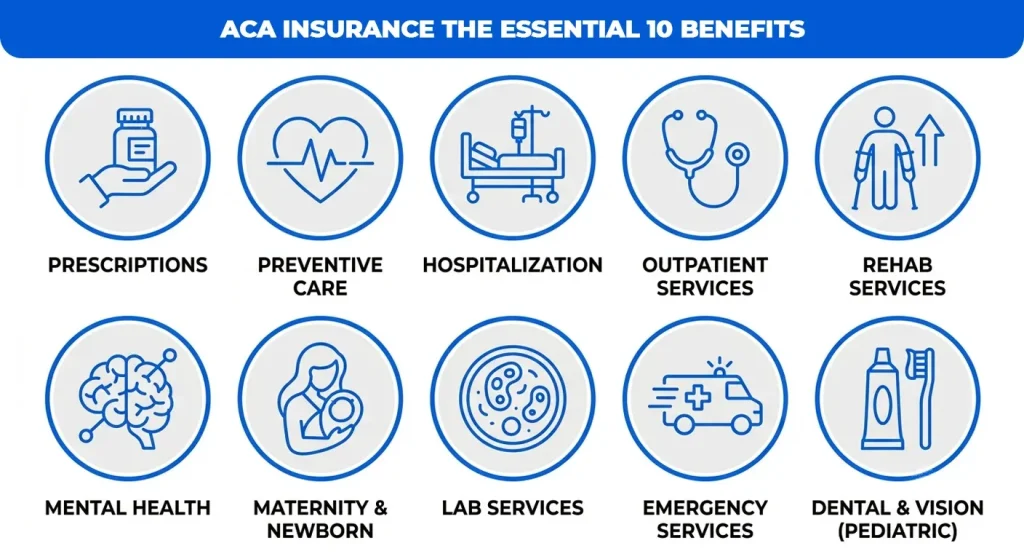
One of the most powerful features of ACA-approved health insurance plans is the guaranteed baseline of coverage. No matter which plan or tier you choose, every ACA-compliant domestic health insurance plan must include all 10 essential health benefits.
The 10 Essential Health Benefits
- Ambulatory patient services (outpatient care)
- Emergency services including ER visits
- Hospitalization, surgery, overnight stays, and serious illness treatment
- Maternity and newborn care pregnancy, labor, and delivery
- Therapy, counseling, and rehabilitation treatments for mental health and substance use disorders
- Prescription drugs covered formulary medications
- Laboratory services blood tests, diagnostic screenings
- Preventive and wellness services annual physicals, vaccinations, screenings
Free Preventive Care: A Benefit You Don’t Want to Miss
Many preventive services are covered at no cost to you – $0 copay and $0 deductible when you use an in-network provider. Under ACA rules, this includes annual wellness visits, blood pressure, cholesterol, mammograms, colonoscopies, and a full schedule of childhood and adult vaccinations.
This is one of the biggest advantages of ACA marketplace health insurance plans over non-ACA options. Preventive care helps catch small health problems before they become costly emergencies.
Understanding Metal Tiers: Choosing the Right ACA Plan
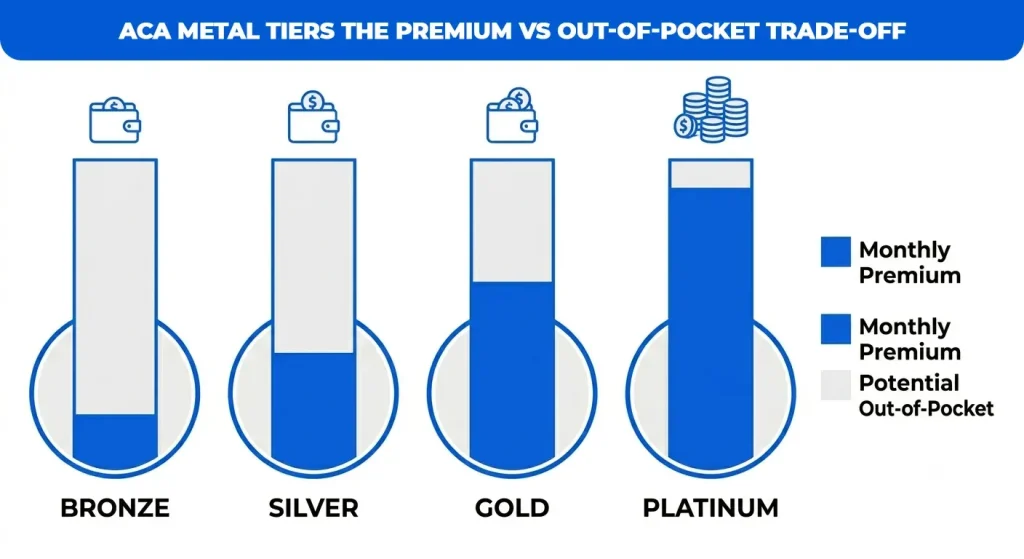
ACA health insurance plans come in four “metal” levels: Bronze, Silver, Gold and Platinum. The tier you choose will determine how costs are shared between you and your insurer. Higher-tier plans mean higher monthly premiums but lower costs when you actually use care.
Think of it as a sliding scale: you pay more each month on a Gold plan, but your deductible and copays are much lower. On a Bronze plan, your monthly bill is smaller, but if you need significant medical care, you’ll pay more out-of-pocket.
| Plan Tier | Monthly Premium | Deductible | Cost Sharing | Best For |
| Bronze | Lowest | High (~$7,000) | 40% you pay | Healthy, low-use |
| Silver | Moderate | Medium (~$4,500) | 30% you pay | CSR subsidy eligible |
| Gold | Higher | Low (~$1,500) | 20% you pay | Frequent care needs |
| Platinum | Highest | Very Low (~$500) | 10% you pay | Chronic conditions |
Note: Actual premium amounts vary by age, location, tobacco use, and plan selected. The above cost-sharing figures are illustrative estimates consistent with 2025-2026 benchmarks. (Source to be verified with the latest data from Healthcare.gov)
Which Tier Is Right for You?
- Bronze: You’re generally healthy, rarely see a doctor, and want the lowest monthly bill. You’re comfortable paying more if something unexpected happens.
- Silver: You want a balance of monthly cost and out-of-pocket protection. Silver is also the only tier eligible for Cost-Sharing Reductions (CSRs) if your income qualifies, making it the best value for many enrollees.
- Gold: You use healthcare regularly, including prescriptions, specialist visits, and therapy. Higher premiums are offset by significantly lower cost-sharing.
- Platinum: You have chronic conditions requiring frequent or high-cost care. The highest premiums, but you’re protected against large bills at every visit.
Eligibility and Enrollment: How to Get Covered
Who Qualifies for ACA Health Insurance Plans?
To enroll in an ACA marketplace health insurance plan, you must meet all three basic eligibility requirements:
- Live in the United States
- Be a U.S. citizen, U.S. national, or have lawful immigration status
- Not be incarcerated (except those awaiting disposition of charges)
You do not need to be employed or have a job to enroll. ACA plans are specifically designed for individuals and families without employer-sponsored coverage, including freelancers, gig workers, early retirees, and part-time employees.
Income-Based Subsidies: Lowering Your Premium
Many people are surprised to find out they qualify for the cheapest ACA health insurance plans, or even $0 premium plans, through the premium tax credit. Eligibility is based on your estimated household income relative to the Federal Poverty Level (FPL).
- Below 100% FPL: May qualify for Medicaid in expansion states
- 100%–400% FPL: Eligible for premium tax credits
- Above 400% FPL: May still qualify for credits under current law (verify current thresholds at Healthcare.gov)
Open Enrollment Period (OEP)
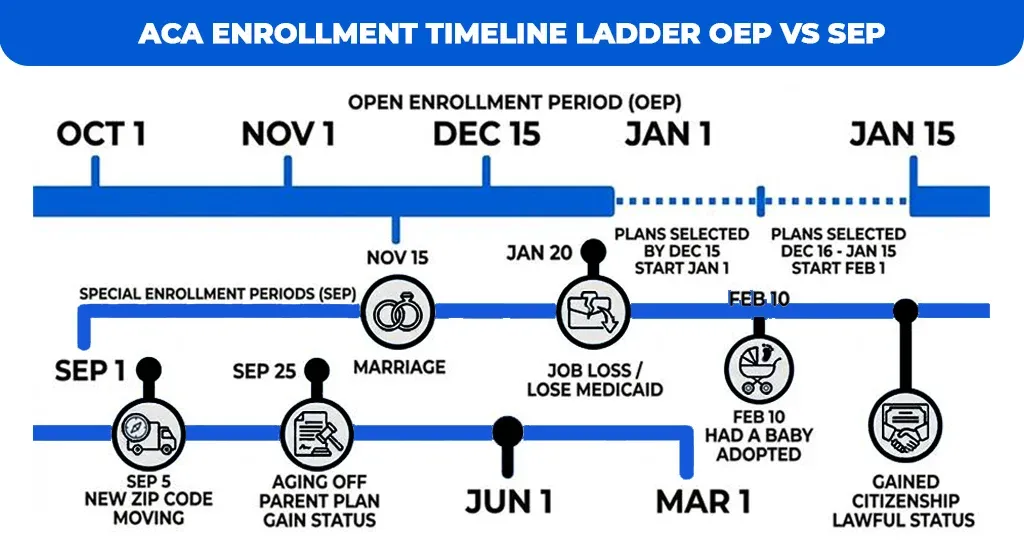
The standard Open Enrollment Period runs November 1 through January 15 in most states. Coverage purchased by December 15 typically starts January 1. Plans selected between December 16 and January 15 usually begin February 1. Some state exchanges have extended deadlines; always check your state’s specific dates.
Special Enrollment Periods (SEPs)
Missed Open Enrollment? You may still qualify if you’ve experienced a qualifying life event in the past 60 days:
- Lost health coverage (job loss, aging off a parent’s plan, losing Medicaid)
- Got married or entered a domestic partnership
- Had a baby, adopted a child, or became a foster parent
- Moved to a new ZIP code or county
- Gained U.S. citizenship or lawful immigration status
- Released from incarceration
| Action Step:Visit Healthcare.gov (or your state’s exchange) right now to check your eligibility and preview plans in your area. You’ll need your estimated household income, Social Security numbers for all covered family members, and employer information if applicable. The tool shows you real prices and subsidy estimates in minutes. |
Conclusion
ACA health insurance plans are fundamentally designed to provide accessible, reliable coverage for everyone, regardless of their health history, income, or employment status. By mandating essential health benefits and offering critical protections for pre-existing conditions alongside income-based subsidies, these plans serve as a vital safety net for those without employer-sponsored insurance.
While the complexity of selecting the right tier can be challenging, understanding these core features empowers you to make an informed decision for your health and finances. Ultimately, this guide is intended to simplify your enrollment journey, ensuring you secure the comprehensive protection you deserve.
Ready to find the right coverage?
Don’t navigate the complex world of insurance alone. At Assurance Guru, we help you compare plans and identify the subsidies you qualify for in minutes. Click here to get your personalized quote from Assurance Guru today!
Frequently Asked Questions
What are ACA health plans?
ACA health plans are policies sold through the federal or state-based Marketplace that comply with the Affordable Care Act’s rules, guaranteeing coverage for ten essential health benefits and providing potential income-based financial subsidies.
Is Parkinson’s disease covered by health insurance?
Yes, Marketplace plans cover Parkinson’s disease and other neurological conditions. Every ACA plan must provide essential benefits, including specialist visits, prescription medications, physical therapy, and occupational therapy without discriminating against your history.
What is the downside of ACA?
Downsides often include premium costs for those not qualifying for subsidies, the complexity of choosing between metal tiers, and sometimes narrower provider networks compared to the plans typically offered by some large employers.
Does health insurance cover erectile dysfunction?
Coverage for erectile dysfunction varies by plan. Prescriptions may be covered if deemed medically necessary, especially when caused by a documented medical condition like diabetes rather than just a lifestyle concern.